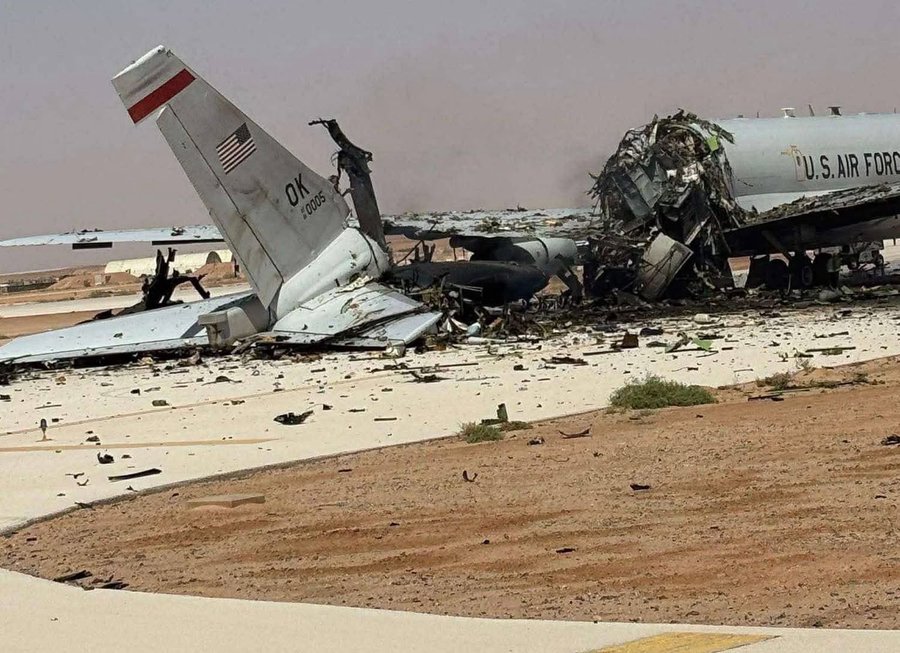
Iranian attack on Saudi airbase damages U.S. aircraft, injuring service members.
Why this matters
The incident highlights vulnerabilities in U.S. military infrastructure and underscores geopolitical tensions in the Middle East.
On March 27, the Iranian attack on Prince Sultan Air Base in Saudi Arabia led to significant damage to U.S. military aircraft, including a possible total loss of a U.S. Air Force E-3 Airborne Warning and Control System (AWACS) aircraft.
Ten U.S. service members were injured, some critically.
Images circulated on social media show what appears to be extensive damage to the E-3. The authenticity of these images is not yet confirmed, though initial assessments suggest they might be genuine. The attack reportedly involved long-range drones and ballistic missiles. Commercial satellite imagery from foreign sources shows notable damage to the base’s main apron. Satellite imagery before the image delays by major U.S. providers, such as Planet Labs, indicates attempts to protect assets by dispersing aircraft across the airfield.
Five other tankers were also damaged earlier in the conflict at Prince Sultan Air Base, a key site for supporting the U.S. war effort. The U.S. had deployed six E-3s to the Middle East before the conflict, and replacements like the E-7 Wedgetail are delayed. Iran has reportedly targeted regional radar installations, with potential targeting data support from Chinese and Russian satellites.
On March 28, Ukrainian President Volodymyr Zelensky met with the Emir of Qatar, Sheikh Tamim bin Hamad Al-Thani, in Doha. During this visit, Qatar and Ukraine finalized a 10-year defense agreement aimed at collaboration in countering missile and drone threats, according to Qatar’s defense ministry. This meeting was part of a series of strategic visits by Zelensky to Gulf nations, where he also signed similar agreements with Saudi Arabia and the United Arab Emirates (UAE).
The agreements focus on technological cooperation, joint investments, and expertise exchange, as Ukraine seeks to leverage its experience in drone warfare for mutual benefit with Gulf states. Educational and industrial cooperation, including building plants and production lines in both Ukraine and the partnered countries, are part of the long-term plans under the agreements.
Zelensky’s Gulf visit also led to talks with UAE President Mohamed bin Zayed Al Nahyan, during which they agreed to further cooperative efforts in security and defense. The Ukrainian president highlighted the economic potential of these agreements, estimating they could be worth billions.
Ukraine has positioned itself as a leading hub in drone development following the 2022 Russian invasion. This reputation has attracted interest from the Middle East, where drone warfare preparedness is a growing concern, a Ukrainian commander noted.
The Republic of Congo’s constitutional court confirmed President Denis Sassou-N’Guesso’s reelection victory on Saturday, granting him a fifth term with 94.90% of the vote.
Sassou-N’Guesso, representing the Congolese Party of Labor, first assumed power in 1979 until 1992 and returned as a militia leader after a civil war in 1997. This election continues a pattern of African leaders maintaining lengthy terms in office. Sassou-N’Guesso is the continent’s third-longest-serving president, following Cameroon’s Paul Biya and Equatorial Guinea’s Teodoro Obiang Nguema Mbasogo.
During the campaign, Sassou-N’Guesso stood out as the only candidate to tour the country for votes. Roads in Brazzaville featured his images prominently. Notably, two major parties boycotted the elections over allegations of unfair practices.
A 2015 constitutional referendum removed age and term limits, permitting Sassou-N’Guesso to run again.
The Republic of Congo faces significant challenges, with high international debt at 94.5% of its GDP and increasing unemployment rates, especially among the youth. Over half the population of 5.7 million lives in poverty, with 47% under the age of 18.
North Korean leader Kim Jong Un oversaw a test of an upgraded solid-fuel rocket engine, marking progress in the country’s weapons program, state media reported. The recent test, achieving a thrust of 2,500 kilonewtons, was confirmed by the Korean Central News Agency (KCNA).
According to KCNA, this test is aligned with the national defense development goals under the new five-year plan. The latest engine surpassed a previously reported thrust of 1,971 kilonewtons from September, indicating a potential capability for global-range ICBMs. Analyst Hong Min from the Korea Institute for National Unification highlighted that this development could enable North Korea to overwhelm missile defense systems.
Photos from KCNA show Kim examining parts of the engine, accompanied by officials. An image of the test depicted flames from the engine, lighting up the site. Kim stated the developments mark a significant change in North Korea’s strategic forces.
Lee Ho-ryung of the Korea Institute for Defense Analyses noted that North Korea has already demonstrated the ability to launch a missile capable of reaching the U.S. mainland. The focus now shifts to whether such missiles could carry multiple warheads, thereby increasing their impact and defense-challenging capability. Lee emphasized that testing a multi-warhead ICBM would be necessary to show mastery of the required technology.
Iran declared its intent to target the USS Abraham Lincoln aircraft carrier if it enters missile range. Iran’s navy chief issued this statement following remarks from Iranian Parliament Speaker Mohammad Bagher Ghalibaf, who accused the United States of preparing a ground assault on Iran while simultaneously pursuing diplomatic channels.
In Islamabad, Middle East powers are holding talks to mediate the conflict. These discussions aim to find an end to the ongoing hostilities in the region.
The Pentagon is preparing for limited ground operations in Iran, potentially including raids on Kharg Island and coastal areas near the Strait of Hormuz, according to The Washington Post. The plans, which do not constitute a full invasion, may involve special operations and conventional infantry troops, posing risks from Iranian drones, missiles, and improvised explosives.
Uncertainty remains over whether President Donald Trump will approve these plans. White House Press Secretary Karoline Leavitt stated, “It’s the job of the Pentagon to make preparations in order to give the Commander in Chief maximum optionality. It does not mean the president has made a decision.”
Officials informed The Washington Post that seizing Kharg Island, an Iranian oil export hub, and conducting raids in coastal areas are under consideration. The timeline for these operations is estimated to take “weeks, not months,” though some suggest it could be “a couple of months.”
Iran has not responded to the reports. Mohammad Bagher Ghalibaf, speaker of the Iranian parliament, indicated that Iran is prepared for potential U.S. ground attacks, stating, “Our missiles are in place,” according to Tasnim news agency.
The situation in the region is further complicated by ongoing mediation efforts, with Pakistan hosting talks between the U.S., Iran, and other regional powers. Meanwhile, Iranian military leaders, including navy chief Shahram Irani, have issued warnings about potential responses to U.S. military actions, including targeting the USS Abraham Lincoln aircraft carrier if it comes within range.