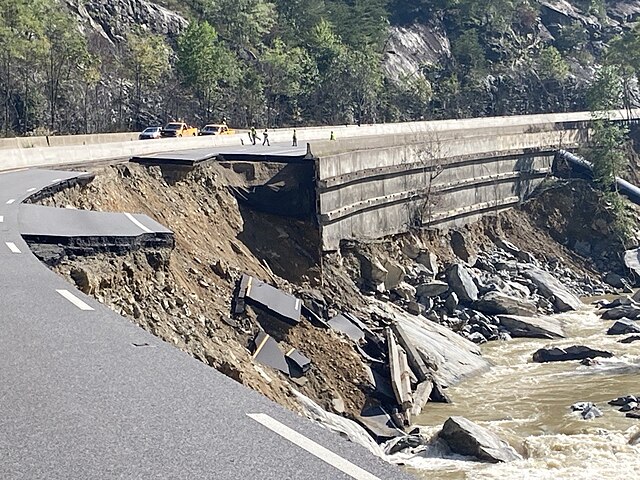
North Carolina Gov. Josh Stein on Thursday welcomed new federal disaster relief funding and said he will continue urging Congress to approve an additional $13.5 billion to aid recovery from Hurricane Helene.
The Federal Emergency Management Agency (FEMA) this week approved $116 million in disaster relief. U.S. Rep. Chuck Edwards, a Republican representing North Carolina’s 11th District, said $72 million will come from FEMA’s Public Assistance program, with $44.6 million through its Hazard Mitigation Grant Program.
Under the mitigation program, local governments may use funds to purchase properties in flood zones, converting the land to permanent open space.
Stein said the new funding will allow some recovery efforts to advance, such as elevating 14 homes in Beaufort County. He called it “a constructive development,” though acknowledged ongoing delays.
Stein also noted that FEMA has taken over a year to process some applications.
“The longer the delay in federal funding and getting programs up and running, the worse it is for western North Carolina recovery,” he said.
Since Hurricane Helene struck 16 months ago, North Carolina has spent more than $3.1 billion on recovery. Congress has previously allocated $7 billion in federal disaster aid, but state officials estimate the hurricane caused $60 billion in damage.
The $13.5 billion request, first made in September 2025, includes $8.37 billion to help homeowners rebuild. Stein, a Democrat, said the state’s congressional delegation supports the request on a bipartisan basis.
“There was just unanimity that Washington needs to do more,” he said.
Stein also addressed new public safety concerns about drones, citing discussions among members of the Council of Governments, which he co-chairs. He warned that drones could be used maliciously at large events or to target infrastructure.
“It quickly became apparent to our group that the malicious use of drones can become a real problem around the country,” Stein said. “The potential that weaponized drones can be used by bad actors to attack large public gatherings for critical infrastructure; it isn’t fiction.”
Congress addressed some of these concerns in December, passing the Safer Skies Act as part of the National Defense Authorization Act. Trump signed the measure into law. States may now gain authority to take action against drones deemed threats after undergoing federal training.
Previously, local officials could act against drones only in limited circumstances, such as in cases involving prison contraband.
“The current law only holds accountable the person who is directing the drone, but that person may be miles away,” Stein said. “But the drone is right there and presents a real and clear present danger.”
North Carolina Public Safety Secretary Jeff Smythe said the state would focus on protecting key infrastructure and providing law enforcement with clear operational guidelines.
“This is not about expanding surveillance,” Smythe said. “It’s about preventing harm and keeping pace with modern risks.”
Stein said he was drafting a proposal outlining the state’s framework for drone regulation but did not share details.