Taliban Releases U.S. Citizen Held for Over a Year

Summary

The Taliban released U.S. citizen Dennis Coyle after more than a year in detention.

Why this matters

This release highlights ongoing geopolitical tensions and the complex diplomacy involved in securing the freedom of detained foreign nationals.

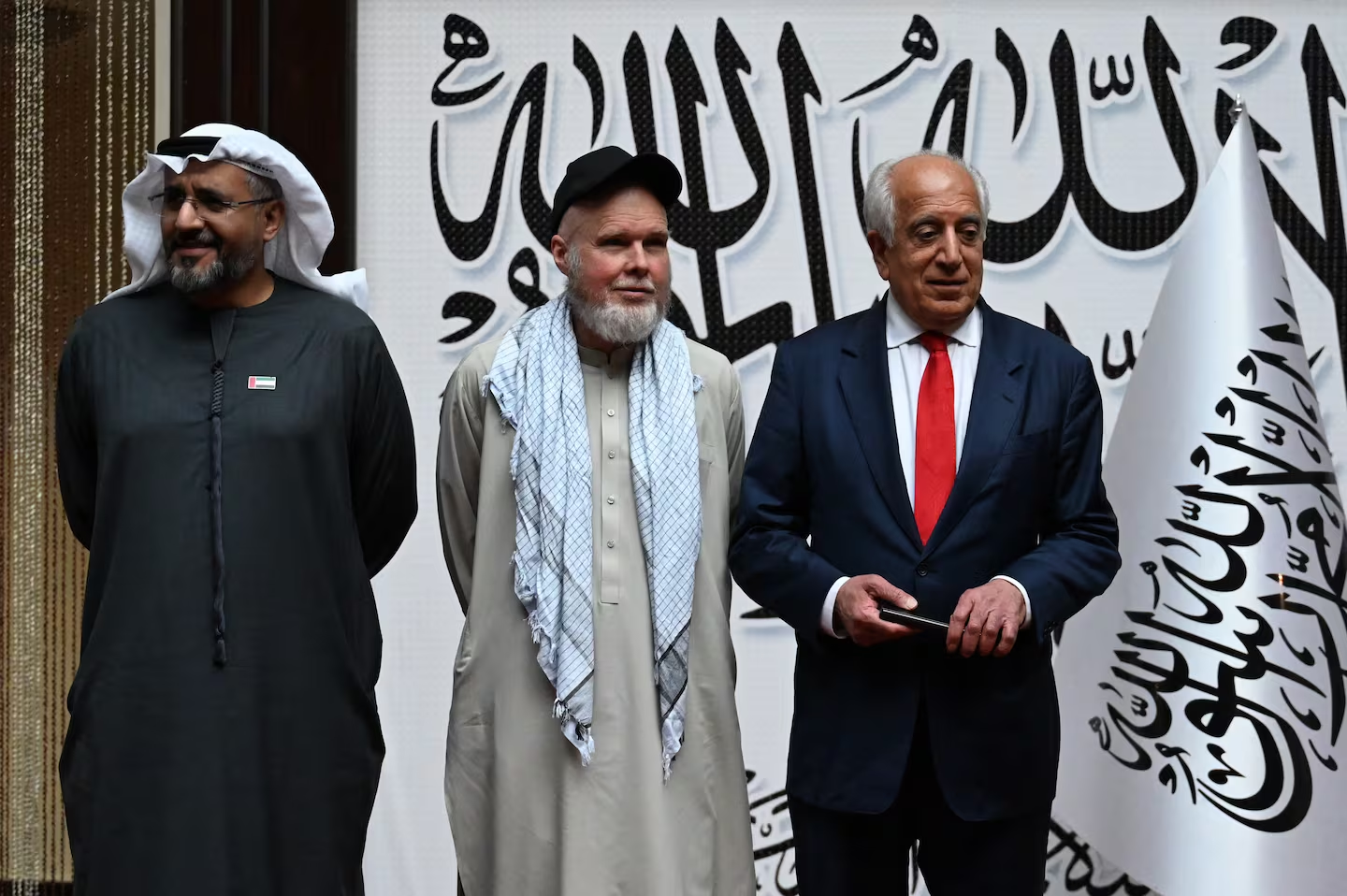
Dennis Coyle, a U.S. citizen detained in Afghanistan for more than a year, was released by the Taliban on March 24, 2026. The U.S. State Department confirmed his release, which occurred after the Coyle family appealed to Afghanistan’s supreme leader for clemency during Eid.

The Afghan Foreign Ministry announced the decision after a meeting involving key figures, including the former U.S. special envoy to Afghanistan, Zalmay Khalilzad, and the UAE ambassador to Kabul, Saif Mohammed Al-Ketbi.

Coyle, a linguist and researcher, was arrested in January 2025. His family’s website, freedenniscoyle.com, stated he was in Afghanistan legally, working on academic research to support local communities.

The family alleged Coyle was held in near-solitary confinement and lacked access to proper medical care. Coyle’s longstanding connection to Afghanistan dates back to the early 2000s, when he contributed to developing linguistic resources for Afghan communities.

The U.S. recently listed Afghanistan among countries involved in wrongful detentions, a move the Afghan government described as “regrettable.” Efforts involving mediators from Qatar have previously led to the release of other American citizens.

In 2025, the Taliban released five American citizens as a goodwill gesture.

Get Camp Lejeune & New River Updates

Essential base alerts, local events, and military news delivered to your inbox

We don’t spam! Read our privacy policy for more info.


  • Minnesota Sues Trump Administration Over Shooting Evidence
    Minnesota officials filed a lawsuit against the Trump administration seeking access to evidence in three shootings by federal officers, including the fatalities of Renee Good and Alex Pretti. The state claims the federal government broke promises to cooperate with investigations after increased federal enforcement in Minneapolis. Hennepin County Attorney Mary Moriarty announced the suit, emphasizing the state’s demand for “transparency and accountability.” Minnesota leaders argue they require their own investigations due to concerns about federal oversight. They assert jurisdiction disputes with the Trump administration, which argues the state lacks authority. The lawsuit follows Operation Metro Surge, a large-scale immigration enforcement in the Minneapolis-St. Paul area. The Department of Homeland Security praised the operation as a success, while Minnesota officials criticized the conduct of federal officers. The state’s filing claims withholding evidence violates Minnesota’s right to investigate potential criminal law breaches. The suit also seeks evidence related to Julio Cesar Sosa-Celis, wounded by a federal officer. Initial charges against him were dropped, and a probe into possible false testimony by immigration officers was opened. Federal officials stated a federal civil rights probe was launched into Pretti’s death, but not Good’s, marking a shift from past practices. Deputy Attorney General Todd Blanche noted that not all shootings warrant federal investigation. Minnesota state investigations aim to address public distrust of federal probes, with Moriarty citing over 1,000 public tips about the shootings.
  • Taliban Releases U.S. Citizen Held for Over a Year
    Dennis Coyle, a U.S. citizen detained in Afghanistan for more than a year, was released by the Taliban on March 24, 2026. The U.S. State Department confirmed his release, which occurred after the Coyle family appealed to Afghanistan’s supreme leader for clemency during Eid. The Afghan Foreign Ministry announced the decision after a meeting involving key figures, including the former U.S. special envoy to Afghanistan, Zalmay Khalilzad, and the UAE ambassador to Kabul, Saif Mohammed Al-Ketbi. Coyle, a linguist and researcher, was arrested in January 2025. His family’s website, freedenniscoyle.com, stated he was in Afghanistan legally, working on academic research to support local communities. The family alleged Coyle was held in near-solitary confinement and lacked access to proper medical care. Coyle’s longstanding connection to Afghanistan dates back to the early 2000s, when he contributed to developing linguistic resources for Afghan communities. The U.S. recently listed Afghanistan among countries involved in wrongful detentions, a move the Afghan government described as “regrettable.” Efforts involving mediators from Qatar have previously led to the release of other American citizens. In 2025, the Taliban released five American citizens as a goodwill gesture.
  • U.S., TotalEnergies Redirect Wind Funds to Natural Gas
    U.S. Interior Secretary Doug Burgum and TotalEnergies CEO Patrick Pouyanne signed an agreement in Houston to redirect $928 million from offshore wind projects to natural gas initiatives. At the CERAWeek conference, Burgum stated the funds, originally tied to wind farm leases near North Carolina and New York, would now support projects like the Rio Grande LNG plant. TotalEnergies had four gigawatts of offshore wind projects, including the New York Bight, paused due to licensing uncertainties during the Trump presidency. The Trump administration had halted five wind projects citing national security risks, a decision later reversed by federal courts. Pouyanne noted natural gas is a more affordable energy source compared to offshore wind. Meanwhile, TotalEnergies committed to a letter of intent with Glenfarne for the long-term procurement of LNG from an Alaska project.
  • EU, Australia Finalize Free Trade Deal Amid Energy Concerns
    Australian Prime Minister Anthony Albanese and European Commission President Ursula von der Leyen finalized a long-negotiated free trade agreement during talks in Canberra on March 24, 2026. The deal aims to enhance exports and operations amid growing global trade uncertainties. Von der Leyen’s visit, accompanied by Trade Commissioner Maros Sefcovic, underscores the EU’s push to diversify trade in light of challenges presented by the United States and China. The agreement also includes measures to enhance defense cooperation and secure critical raw materials. Addressing the Australian Parliament, von der Leyen emphasized the shared values between the EU and Australia, highlighting the necessity to reduce dependency on China for essential minerals. “We cannot be over dependent on any supplier for such crucial ingredients, and that is precisely why we need each other,” she stated. After eight years of negotiations, key obstacles such as Australian labeling of European geographical names and beef exports to Europe were resolved. Australian winemakers can use ‘prosecco’ domestically but must cease its export use in ten years. Some geographical names like feta and gruyere will remain permissible where established usage exceeds five years. The deal will enable European car manufacturers to benefit as Australia raises the luxury car tax threshold for electric vehicles, allowing 75% of such vehicles exemptions. The EU expects its exports to Australia to increase by a third over a decade. In exchange, the EU will significantly expand the quota for Australian beef imports but still fall short of Australian farmers’ aspirations. In 2025, EU firms exported goods worth €37 billion ($42.9 billion) to Australia and €31 billion in services in 2024. Australia’s major export markets remain China and the U.S., but it is keen to diversify its markets post-2020 trade issues with China.
  • U.S., U.K. Collaborate on Underwater Drone Defense
    The United States and the United Kingdom are partnering to address potential threats posed by underwater drones to ports and critical infrastructures. According to a solicitation by the Pentagon’s Defense Innovation Unit (DIU), the countries aim to develop a comprehensive system capable of detecting and neutralizing various types of unmanned underwater vehicles, remotely operated vehicles, and semisubmersibles. The Robotic Exclusion and Engagement Framework (REEF) project focuses on securing ports and harbors from underwater threats of different sizes and complexities, while also aiming to safeguard all U.S. critical waterways. The DIU plans to leverage off-the-shelf technologies, including sensors and artificial intelligence, to create a quick-deploy solution. The anticipated system may utilize fixed components like moored buoys and cables or mobile elements like USVs, UUVs, UAVs, and drifting buoys. The system is expected to distinguish between hostile drones and non-threatening entities, such as marine life or commercial vessels, providing sufficient time for human decision-makers to respond effectively. It will incorporate both kinetic and nonkinetic methods for neutralization. Nonkinetic strategies may involve deployable nets or bubble curtains, while kinetic options could include acoustic energy or physical coupling devices. The DIU expressed a preference for nonkinetic solutions. Decoys will play a significant role in the REEF initiative, using signals to mislead adversarial underwater crafts. The system should require minimal training, utilize AI for operational suggestions, and be compatible with existing U.S. command-and-control systems. Cooperation with the U.K. will be facilitated by a 2024 Department of Commerce rule that permits the sharing of certain controlled items with Britain, allowing British businesses to benefit from export control relief.