
The number of U.S. service members wounded in the war with Iran has surpassed 600, according to the Pentagon’s casualty tracking database.
The Defense Casualty Analysis System listed 207 wounded in Operation Epic Fury and 417 in a separate category labeled “overseas operations,” which began July 7, for a combined total of 624.
Pentagon spokesman Sean Parnell said last week that nearly 100 service members had been wounded in retaliatory attacks since July 7. The database now lists 207 wounded in that category, most of them Army personnel.
Eighteen U.S. service members have been killed in the war, including four in the weeks since armed combat resumed after a tentative ceasefire collapsed.
The latest figures came as U.S. forces went three consecutive days without reporting strikes on Iran after nearly two weeks of attacks over the Strait of Hormuz.
President Donald Trump informed Congress on July 7 that the United States was again at war with Iran. The administration said that restarted the 60-day period in which a president can use military force without congressional approval.
U.S. Central Command halted attacks on Iran on Friday after 13 consecutive days of strikes on Iranian air defenses, coastal surveillance sites, and drone and missile storage facilities.
U.S. Ambassador to the United Nations Mike Waltz said Sunday that the pause was intended to allow diplomacy to continue.
“What the president is doing right now, as we’ve seen all along, is giving some talks some space,” he told NBC’s “Meet the Press.”
Waltz did not rule out further military action.
“The U.S. military is locked and loaded,” he said. “In fact, more assets have gone into the region.”
Various news outlets reported that concerns about munitions stockpiles contributed to the pause. U.S. forces have used Patriot and Terminal High Altitude Area Defense systems to intercept Iranian missiles and drones over the past five months.
Waltz said Trump inherited reduced stockpiles from the Biden administration, which used the weapons to support Ukraine and combat Yemen’s Houthi militant group. He rejected reports of shortages.
“The people that are leaking this nonsense deserve to be in jail,” he said.
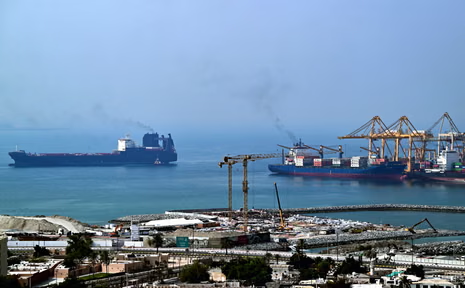
The war began Feb. 28 with joint U.S.-Israeli strikes that killed many of Iran’s top leaders. Fighting later centered on the Strait of Hormuz, through which nearly a fifth of the world’s oil typically passes.
Earlier this month, the U.S. Navy reinstated a naval blockade on Iranian ports after Tehran fired on oil tankers it said were transiting the waterway without permission. Brent crude traded near $85 a barrel on Monday, up from June levels but below its May peak of $118.