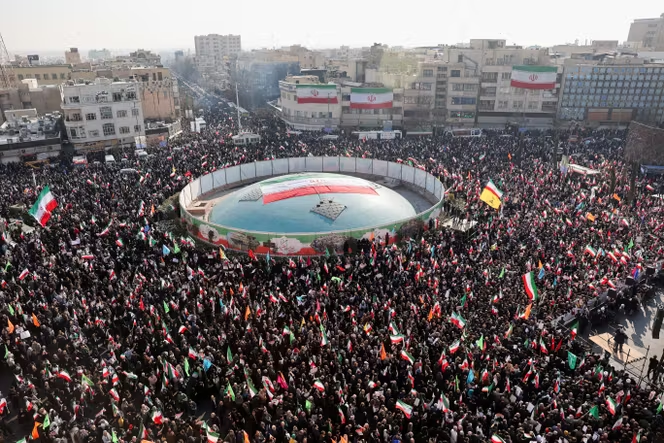
U.S. Treasury Secretary Scott Bessent said the United States deliberately created a shortage of U.S. dollars in Iran, contributing to a steep decline in the Iranian rial and sparking nationwide protests.
Speaking at a congressional hearing last week, Bessent said the Treasury “created a dollar shortage” in Iran that culminated in December 2025 with the collapse of one of Iran’s largest banks, a sharp currency depreciation, and rising inflation.
“We have seen the Iranian people out on the street,” Bessent said. “We have seen the Iranian leadership wiring money out of the country like crazy. So the rats are leaving the ship.”
Bessent also discussed the policy in an earlier interview at the World Economic Forum in Davos and in remarks delivered in March 2024 at the Economic Club of New York. He credited the strategy to President Donald Trump’s “maximum pressure” policy targeting Iran’s economy.
Iran experienced major antigovernment protests starting December 28, 2025, after the rial hit a record low of 1.5 million to the U.S. dollar. The unrest, which began with shopkeepers in Tehran, expanded to other provinces. Analysts linked the demonstrations to food prices rising 72% year over year and broader inflation pressures.
Iranian authorities cracked down on the protests. Rights groups estimate more than 6,800 people, including at least 150 children, died in the response.
Economist Mohammad Reza Farzanegan of Germany’s Marburg University said the U.S. sanctions targeted both Iranian oil exports and access to the international financial system, limiting Iran’s ability to earn or access dollars. He said these sanctions discouraged companies from engaging with Iran even in sectors such as medicine and humanitarian goods.
Farzanegan and co-author Nader Habibi found that these economic constraints significantly reduced Iran’s middle class. Their research estimated Iran’s middle-class share could have grown by 17 percentage points annually from 2012 to 2019 without the sanctions. Instead, it fell by 28 percentage points in 2019.
Bruce Fein, a former U.S. associate deputy attorney general, said economic sanctions are a common tool of U.S. foreign policy. He added, however, that sanctions alone are rarely sufficient to topple governments.
Farzanegan noted that while Iran has longstanding mechanisms to evade sanctions, external shocks combined with internal vulnerabilities—including overdependence on oil, corruption, and economic mismanagement—have deepened the crisis. He said the lack of structural reforms limited the country’s ability to absorb economic shocks.
Bessent’s comments have drawn criticism from observers who say targeting the banking system may limit humanitarian exceptions. He called the approach “economic statecraft; no shots fired.”
As of early 2026, the U.S. continues to press Iran on three fronts—its uranium enrichment, ballistic missile program, and regional support for militias—while both sides engage in talks amid heightened regional tensions. A U.S. naval presence remains in the Arabian Sea.