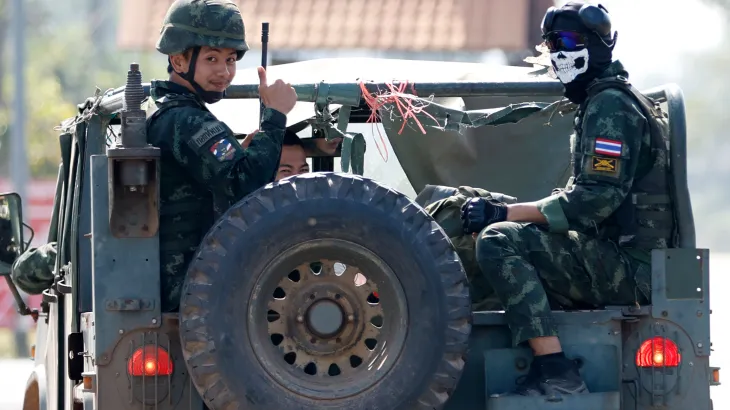
Members of the Venezuelan Coast Guard conducted reinforced patrols on Lake Maracaibo on Oct. 26, 2025, amid heightened tensions with the United States.
The operation followed U.S. President Donald Trump’s announcement of what he called a “total and complete blockade” of sanctioned oil tankers traveling to and from Venezuela. The move escalated months of economic and military pressure on Venezuelan President Nicolas Maduro’s government.
The Venezuelan state oil company Petroleos de Venezuela (PDVSA) said exports continued as usual. “Export operations for crude and byproducts continue normally. Oil tankers linked to PDVSA operations continue to sail with full security,” the company said Wednesday.
Trump, speaking Tuesday, referenced the U.S. military presence in the Caribbean, including an aircraft carrier, and said Venezuela was “completely surrounded by the largest Armada ever assembled in the History of South America.”
He reiterated Wednesday that U.S. forces would block unauthorized traffic, and accused Venezuela of taking American energy resources, appearing to reference the nationalization of Venezuela’s oil industry. “They took all of our energy rights, they took all of our oil, from not that long ago, and we want it back,” he said.
Maduro spoke by phone with United Nations Secretary-General Antonio Guterres, who urged both countries to exercise restraint and de-escalate to preserve regional stability.
Venezuela, which holds the world’s largest proven oil reserves, has long relied on petroleum exports. The country is experiencing a prolonged economic crisis as Maduro’s government faces increasing international pressure.
The Venezuelan military stated Wednesday it was “not intimidated” by U.S. threats.
The United Nations Security Council is scheduled to discuss the situation Tuesday at Venezuela’s request, with support from China and Russia.
Chinese Foreign Minister Wang Yi spoke with Venezuelan Foreign Minister Yvan Gil and expressed support for Venezuela’s national sovereignty. “China opposes all unilateral bullying and supports all countries in defending their sovereignty and national dignity,” he said.
Tensions escalated further after the U.S. military seized the M/T Skipper last week in a helicopter raid. The operation marked a shift in the U.S. approach to Venezuela.
Since August, the U.S. has deployed what it called its largest naval presence in the Caribbean since 1989, citing anti-narcotics efforts. Venezuelan officials have claimed the operations are a pretext for attempting to remove Maduro and gain access to the nation’s oil wealth.
U.S. strikes on vessels in the Caribbean and eastern Pacific have resulted in at least 99 deaths, including four casualties reported Wednesday.
Mexican President Claudia Sheinbaum criticized the U.N.’s limited role and called for increased action to prevent conflict. Brazilian President Luiz Inacio Lula da Silva offered to mediate between the U.S. and Venezuela.
“Things wouldn’t be resolved by shooting, that it was better to sit down around a table to find a solution,” Lula said Thursday. He expressed concern over the motives behind U.S. actions. “It can’t just be about overthrowing Maduro. What are the other interests that we don’t yet know about?” he asked.
Lula said he remained available to facilitate a peaceful resolution.