
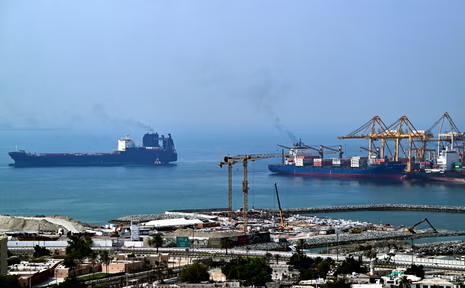
Yemen’s Houthi movement said Thursday it struck two Saudi oil tankers in the Red Sea as part of what it called a naval blockade on Saudi Arabia, adding to risks for oil shipments already disrupted by fighting involving Iran.
The Houthis, who control areas near the Bab el-Mandeb Strait, said earlier this week they were imposing a blockade on Saudi Arabia. The U.S. military said Wednesday it had launched a new round of strikes on Iran at President Donald Trump’s direction, the 12th straight night of U.S. attacks.
The Houthis said their forces used missiles and drones to attack the Saudi tankers Encelia and Layla in the Red Sea.
A maritime security source said Encelia sent a distress call after reporting it had been struck by a missile near the Saudi port of Jizan late Wednesday. British maritime risk management group Vanguard said the Saudi-flagged tanker was hit by an unknown projectile on its starboard side about 70 nautical miles southwest of Al Shuqaiq.
Shipping disruptions were already building. Five tankers changed course in the Red Sea on Wednesday to avoid the Bab el-Mandeb Strait, and three tankers carrying Saudi oil to China and India turned back on Tuesday.
Saudi oil shipments had increasingly been routed to the Red Sea port of Yanbu to avoid the Strait of Hormuz. If traffic through the Bab el-Mandeb is also disrupted, ships would be left with a northern route through the Suez Canal, adding weeks to voyages and raising costs.
Trump said Wednesday the United States would strike an Iranian bridge or power plant each time Iran fired at a ship in the Strait of Hormuz. Iran’s joint military command said, according to Iranian state media, that if such threats were carried out, Iranian forces would target regional oil, gas, electricity, and economic infrastructure and stop the export of “even a single drop of oil.”
Hours later, Iran’s Revolutionary Guards said an explosion occurred on what they described as a mined route south of the Strait of Hormuz, with one of three oil tankers catching fire and the other two turning back. They said the strait was under their control and “completely closed.”
Iranian state media said Thursday the United States attacked one location in Bushehr, near Iran’s only operating commercial nuclear power reactor, for the second time in two days.